Enviromax Asbestos Consulting Ltd. provides professional final asbestos air clearance and air monitoring services across British Columbia’s Lower Mainland and Fraser Valley. Working alongside property owners, contractors, restoration firms, and strata corporations, Enviromax conducts post-abatement air sampling and visual inspections to document airborne fibre levels after asbestos disturbance or removal work has been completed.
Our Asbestos Air Monitoring Services
Enviromax supports residential, commercial, and institutional projects with independent air monitoring at key stages of abatement and restoration:
- Final Asbestos Air Clearance: Post-abatement air sampling performed inside a containment area after cleanup and prior to dismantling protective barriers.
- Post-Abatement Visual Inspections: Detailed visual assessments of work surfaces and containment zones to check for visible dust or debris before air sampling begins.
- Containment and Perimeter Air Monitoring: Ongoing air sampling conducted outside active work enclosures to monitor containment integrity during abatement.
- Occupational Air Monitoring: Personal and area sampling designed to assess worker exposure levels in accordance with applicable WorkSafeBC requirements.
- Clean-Room Air Monitoring: Air testing within decontamination enclosures to verify air quality in transition zones.
- Air Monitoring Documentation: Written clearance reports and laboratory analytical records prepared for project files, contractors, and property managers.
What Is Final Asbestos Air Clearance?
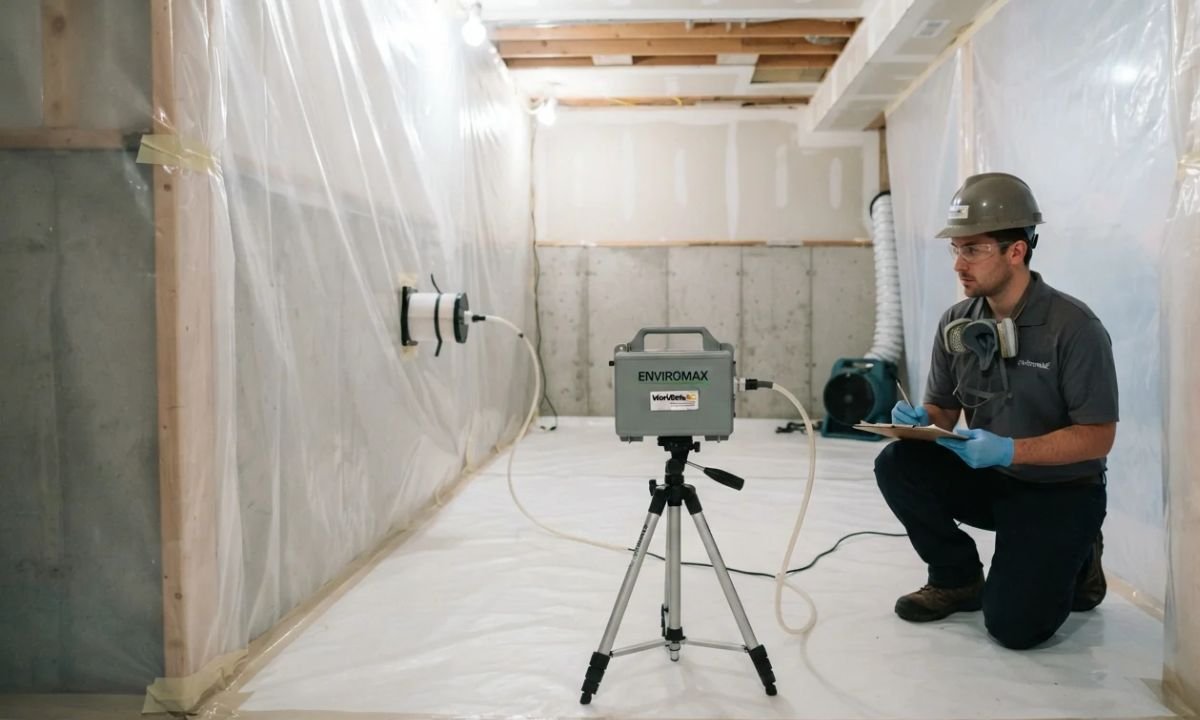
Final asbestos air clearance is a post-abatement verification process carried out once asbestos-containing materials have been removed, encapsulated, or enclosed, and the work area has been thoroughly cleaned. Before containment barriers and negative air units are taken down, an independent technician inspects the space and collects air samples to measure airborne fibre concentrations.
The objective is to confirm that airborne fibre levels within the work area meet applicable clearance criteria before normal occupancy or follow-up construction resumes. Because airborne asbestos fibres are microscopic and cannot be detected by sight, air sampling combined with laboratory analysis provides objective data on air quality inside the enclosure.
Post-Abatement Visual Inspection and Sampling Process
A structured final clearance typically follows a clear sequence to ensure accurate results:
- Pre-Sampling Visual Inspection: Before setting up air pumps, the technician inspects the containment area, polyethylene sheeting, framing, and cleaned surfaces to verify that visible dust, residue, and debris have been removed.
- Air Sample Collection: Calibrated air sampling pumps draw a measured volume of air through specialized filter cassettes positioned inside the containment zone. Depending on the scope and risk level of the work, aggressive sampling techniques may be used where appropriate to simulate normal air movement.
- Laboratory Analysis: Sealed filter cassettes are submitted for laboratory analysis to determine airborne fibre concentrations.
- Clearance Documentation: Once analytical results are reviewed and clearance criteria are met, Enviromax issues formal documentation confirming that the containment area has passed final clearance and can be dismantled.
When Is Final Asbestos Air Clearance Needed?
Final asbestos air clearance may be required or appropriate following projects where asbestos-containing materials have been disturbed or removed under containment. Common situations include:
- Moderate- and High-Risk Abatement Projects: Removal of friable materials such as textured ceilings, pipe insulation, vermiculite, or plaster where containment and negative air pressure are established.
- Residential and Strata Renovations: Kitchen, bathroom, or whole-home remodels in older British Columbia buildings where asbestos abatement precedes general reconstruction.
- Commercial and Institutional Upgrades: Tenant improvements, mechanical room upgrades, and facility renovations requiring documented clearance before trades re-enter the space.
- Emergency Restoration Work: Post-fire or water-damage remediation where asbestos-containing building materials were affected and removed prior to structural drying or rebuilding.
- Pre-Demolition Abatement: Selective hazardous material removal prior to structural demolition, depending on project-specific requirements.
Independent Asbestos Air Monitoring
Separating the abatement contractor from the air monitoring provider helps maintain objectivity and clear accountability on site. Enviromax operates independently to provide third-party oversight and documentation for:
- Homeowners and Property Owners: Objective verification that living or working spaces have undergone post-abatement air testing before containment is removed.
- General and Renovation Contractors: Clear clearance documentation before scheduling painters, electricians, plumbers, or flooring installers back into the work zone.
- Asbestos Abatement Contractors: Reliable scheduling for visual inspections, perimeter monitoring, and final clearance sampling to keep project timelines moving.
- Restoration Companies: Timely clearance reporting following water or fire loss abatement so reconstruction phases can proceed smoothly.
- Property Managers and Strata Corporations: Transparent records for building files, unit owners, and boards when abatement occurs in common areas or individual units.
Renovation, Restoration & Demolition Projects
In British Columbia, many residential homes, multi-unit strata complexes, and commercial buildings constructed prior to the 1990s contain asbestos in drywall joint compound, vinyl flooring, stucco, insulation, or ceiling textures. When these materials are identified through [Asbestos Testing] and subsequently removed through professional [Asbestos Removal], final air clearance serves as the bridge between abatement and the next phase of construction.
Integrating [Air Monitoring] and final clearance into the project schedule helps prevent costly delays. Coordinating sampling ahead of containment teardown ensures that tradespeople, property managers, and occupants receive clear documentation before work resumes.
Service Areas – British Columbia
Enviromax Asbestos Consulting Ltd. provides final asbestos air clearance and air monitoring services across communities in British Columbia’s Lower Mainland and Fraser Valley:
Lower Mainland / Metro Vancouver
- Vancouver
- Burnaby
- Richmond
- Surrey
- Delta
- White Rock
- New Westminster
- Coquitlam
- Port Coquitlam
- Port Moody
- Maple Ridge
- Pitt Meadows
- North Vancouver
- West Vancouver
Fraser Valley
- Langley
- Abbotsford
- Mission
- Chilliwack
- District of Hope
- Agassiz
- Harrison Hot Springs
- Kent
Why Choose Enviromax Asbestos Consulting?
Enviromax Asbestos Consulting Ltd. (WorkSafeBC Asbestos Licence: AAL-00001650) delivers dependable asbestos testing, hazardous materials surveys, air monitoring, and air clearance services across the Lower Mainland and Fraser Valley. Our team supports residential, commercial, restoration, renovation, demolition, and construction projects with:
- Professional Sampling: Careful visual inspections and calibrated air sampling tailored to the containment setup and scope of abatement.
- Clear Documentation: Straightforward clearance reports and analytical records suitable for contractors, property owners, and project files.
- Project-Specific Monitoring: Practical scheduling and monitoring aligned with the risk level and timeline of your site.
- Responsive Service: Direct communication from initial booking through laboratory reporting to help minimize project downtime.
Frequently Asked Questions
What is final asbestos air clearance?
Final asbestos air clearance is a post-abatement inspection and air sampling process performed inside a sealed work area after asbestos removal and cleanup are complete. It measures airborne fibre concentrations to verify that the space meets applicable clearance criteria before containment barriers are dismantled.
When is final asbestos air clearance required?
Final air clearance is typically required following moderate- or high-risk asbestos abatement performed inside a containment enclosure, or whenever project specifications, property managers, or applicable WorkSafeBC requirements call for documented post-abatement air testing before re-occupancy.
What happens during a post-abatement visual inspection?
Before air pumps are run, a technician inspects all surfaces, framing, and polyethylene barriers inside the containment zone to check for any remaining dust, residue, or debris. Air sampling only begins once the area passes this visual check.
Can containment barriers be taken down before final clearance results are received?
No. Containment barriers and negative air units must remain intact and operating until the visual inspection is passed, air samples are analyzed, and formal clearance confirmation is issued.
How long does final asbestos air clearance take?
On-site visual inspection and air sample collection generally take a few hours, depending on the size of the containment area and the required air volume. Turnaround time for laboratory analysis and final reporting varies based on project urgency and laboratory scheduling.
Who should arrange final asbestos air clearance?
Final clearance is commonly arranged by the property owner, general contractor, restoration firm, property manager, or abatement contractor prior to the scheduled completion of removal work so there are no delays before containment teardown.
BOOK FINAL ASBESTOS AIR CLEARANCE ENVIROMAX ASBESTOS CONSULTING LTD.
Asbestos Testing | Air Monitoring | Air Clearance | Hazardous Materials Surveys
Call: 236-838-2640
Email: ENVIROMAX04@GMAIL.COM
Serving the Lower Mainland & Fraser Valley, BC
READ MORE: Containment Air Monitoring British Columbia | Enviromax Asbestos Consulting