Enviromax Asbestos Consulting Ltd. provides professional asbestos testing services across British Columbia, supporting residential, commercial, and industrial property owners. When planning renovations, repairs, or demolition, testing drywall assembly materials—including joint compound, plaster, and textures—helps identify potential hazards before work begins. Our team delivers clear sampling and documentation to help keep your project moving safely and in accordance with applicable WorkSafeBC requirements.
Our Asbestos Testing Services
We offer focused testing solutions tailored to the specific scope of your property and project:
- Drywall Joint Compound & Tape Sampling: Collecting representative samples of joint compound (mud) and tape systems across wall and ceiling assemblies.
- Traditional Plaster Sampling: Testing multi-layer acoustic, decorative, or structural plaster systems commonly found in older structures.
- Textured Ceiling & Wall Testing: Sampling popcorn ceilings, stipple finishes, and decorative skim coats.
- Pre-Renovation Surveys: Targeted hazardous material sampling focused strictly on areas planned for disturbance.
- Pre-Demolition Surveys: Thorough structural sampling prior to full building teardowns or heavy structural alterations.
Asbestos in Drywall Joint Compound and Plaster
In older British Columbia properties, asbestos was frequently added to wall and ceiling finishing materials. While drywall boards themselves rarely contain asbestos, the joint compound (or skim coat) used to cover seams, nails, and textures often does.
Drywall Joint Compound
Drywall joint compound was manufactured with asbestos fibers to improve fire resistance, durability, and smooth application. Because joint compound was applied across entire wall surfaces, sanding or cutting drywall can release fine airborne fibers throughout a space.
Plaster Systems
Traditional lathe and plaster systems, as well as decorative skim coats applied over masonry or lathe, frequently utilized asbestos for binding and soundproofing. Plaster is often thicker and denser than modern drywall, requiring controlled sampling through all applied layers to ensure accurate laboratory results.
Textures and Finishes
Popcorn ceilings, acoustic plaster, spray-applied finishes, and textured wall mud frequently relied on asbestos formulations. These materials are often brittle and prone to releasing fibers if scraped, drilled, or damaged.
When Is Asbestos Testing Needed for Drywall and Plaster?
Disturbing wall or ceiling assemblies without prior verification can create unnecessary safety and financial risks. Asbestos testing for drywall and plaster is generally appropriate during:
- Home Renovations: Kitchen or bathroom remodels involving wall removals, plumbing cut-outs, or fixture updates.
- Drywall Repairs: Patching water damage, rewiring electrical circuits, or installing new fixtures into existing walls.
- Ceiling Refinishing: Scraping popcorn ceiling texture or sanding down textured surfaces to achieve a smooth finish.
- Demolition Projects: Removing internal non-load-bearing walls or completing full interior gutting.
- Restoration Work: Addressing property damage following fire, water intrusion, or mold remediation efforts where walls must be removed.
Professional & Independent Service
Enviromax Asbestos Consulting Ltd. operates strictly as an independent consulting firm. We perform objective sampling, laboratory submission, and clear reporting without performing abatement work ourselves. This independence ensures unbiased assessment results for all client types, including:
- Homeowners and residential property owners
- General contractors and drywall specialists
- Restoration companies and trade contractors
- Property managers and strata corporations
- Commercial property developers
By providing accurate, straightforward documentation, we assist contractors and property owners in planning necessary precautions or arranging Asbestos Removal and Air Monitoring services where applicable.
Renovation, Restoration & Demolition Projects
Drywall and plaster disturbance is standard practice in almost every structural modification. During water damage restoration, wet drywall often needs quick removal to prevent mold growth. Similarly, electrical and plumbing upgrades routinely require cutting channels into existing plaster.
Having materials tested before cutting, sanding, or pulling down walls ensures that workers, occupants, and adjacent spaces are protected. If testing confirms the presence of asbestos in joint compound or plaster, contractors can establish appropriate containment and work controls before physical work begins.
Service Areas – British Columbia
Enviromax Asbestos Consulting Ltd. proudly serves communities throughout Metro Vancouver, the Lower Mainland, and the Fraser Valley, including:
Lower Mainland / Metro Vancouver
- Vancouver
- Burnaby
- Richmond
- Surrey
- Delta
- White Rock
- New Westminster
- Coquitlam
- Port Coquitlam
- Port Moody
- Maple Ridge
- Pitt Meadows
- North Vancouver
- West Vancouver
Fraser Valley
- Langley
- Abbotsford
- Mission
- Chilliwack
- District of Hope
- Agassiz
- Harrison Hot Springs
- Kent
Why Choose Enviromax Asbestos Consulting?
Enviromax Asbestos Consulting Ltd. brings experienced sampling practices and detailed regulatory understanding to every project across British Columbia.
- WorkSafeBC Licensed: Fully licensed firm holding WorkSafeBC Asbestos Licence AAL-00001650.
- Professional Sampling Protocols: Precise sample selection following strict industry practices to avoid unnecessary property damage while ensuring statistical accuracy.
- Clear Documentation: Easy-to-read survey reports suitable for submission to municipalities, trade contractors, and safety regulators.
- Versatile Experience: Proven support for residential renovations, commercial tenant fit-outs, and large-scale restoration efforts.
Frequently Asked Questions
Is asbestos found in the drywall sheet itself or the mud?
In most Canadian properties, asbestos is found within the drywall joint compound (mud) and skim coats rather than the paper-faced gypsum board itself. However, because mud is applied over seams and fasteners across the entire wall surface, the entire assembly must be treated as asbestos-containing if the joint compound tests positive.
Can I tell if my plaster or drywall mud contains asbestos just by looking at it?
No. Asbestos fibers are microscopic and cannot be identified visually. The age of the building can offer a clue, but laboratory analysis using polarized light microscopy (PLM) is the only reliable method to confirm whether drywall compound or plaster contains asbestos.
How are drywall and plaster samples collected?
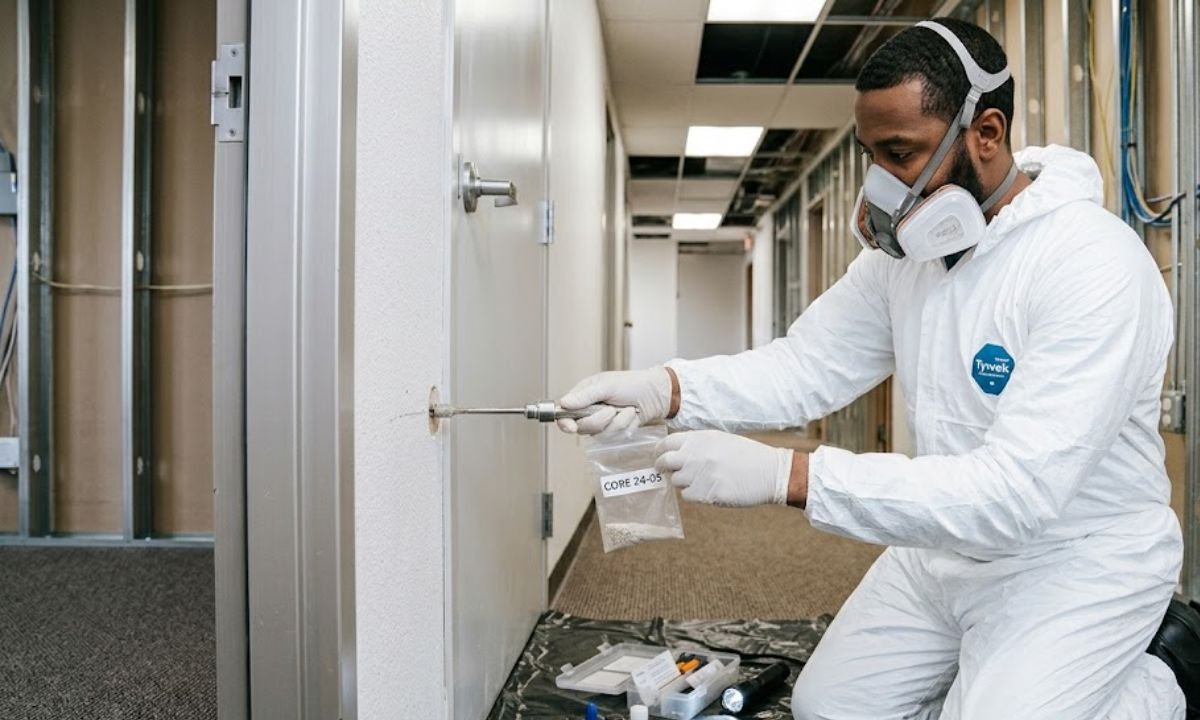
A trained consultant collects small, representative core samples through the depth of the drywall or plaster assembly. These samples are carefully sealed, documented, and sent to an accredited laboratory for analysis.
Is asbestos testing required before cutting into drywall for minor repairs?
Depending on the age of the building and the scope of work, testing is strongly recommended prior to disturbing drywall or plaster. Even minor work like cutting openings for light switches or removing a small section of water-damaged wall can release fibers if asbestos-containing mud is present.
What happens if the test results come back positive for asbestos?
If testing confirms asbestos in the drywall joint compound or plaster, the affected areas must be handled using appropriate control measures and containment during disturbance. Work can then be coordinated with a qualified abatement contractor to perform Asbestos Removal under controlled conditions.
BOOK ASBESTOS TESTING
ENVIROMAX ASBESTOS CONSULTING LTD.
Asbestos Testing | Air Monitoring | Air Clearance | Hazardous Materials Surveys
Call: 236-838-2640
Email: ENVIROMAX04@GMAIL.COM
Serving the Lower Mainland & Fraser Valley, BC
READ MORE: Asbestos Sampling and Laboratory Analysis British Columbia | Enviromax Asbestos Consulting