Enviromax Asbestos Consulting Ltd. provides professional asbestos air monitoring during abatement for projects across British Columbia, serving the Lower Mainland and Fraser Valley. Our air monitoring services help track airborne fibre levels throughout active removal work, verify containment integrity, and establish clear documentation before a work area is returned to normal occupancy. We support residential renovations, commercial upgrades, strata maintenance, restoration claims, and demolition projects where asbestos-containing materials are being disturbed or removed.
Our Asbestos Air Monitoring Services
Depending on the scope and risk level of the abatement work, Enviromax provides targeted air monitoring services designed to match project-specific requirements:
- Occupational Air Monitoring: Sampling collected within the breathing zone of workers to evaluate fibre concentrations during active abatement tasks.
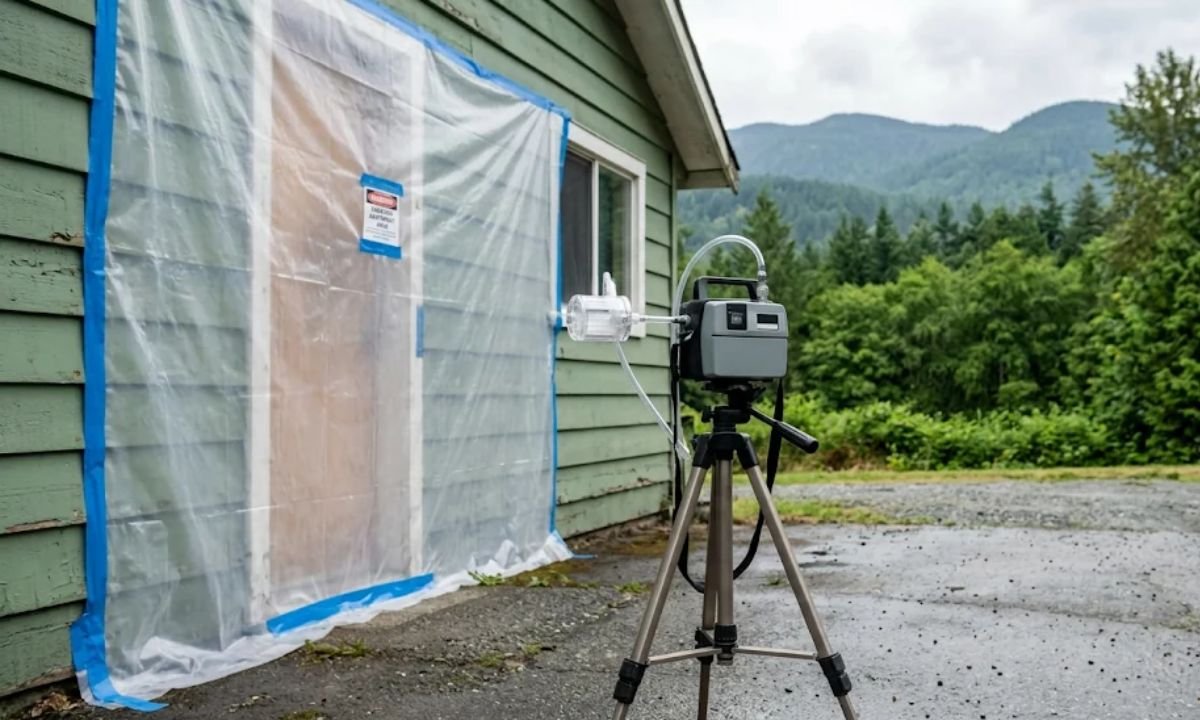
- Containment and Perimeter Air Monitoring: Air sampling positioned outside containment barriers, negative-pressure enclosures, and adjacent occupied spaces to help confirm that fibres are not migrating beyond the work zone.
- Clean-Room and Decontamination Monitoring: Sampling near entry and exit chambers to verify that decontamination setups are functioning properly during removal work.
- Ambient Air Monitoring: Baseline and ongoing air sampling in surrounding building areas to track airborne conditions throughout the project.
- Final Asbestos Air Clearance: Post-abatement visual inspection and clearance air sampling conducted after removal and cleanup are complete to verify that airborne fibre levels meet applicable WorkSafeBC requirements before containment is dismantled.
Understanding Asbestos Air Monitoring During Abatement
Disturbing asbestos-containing materials can release microscopic fibres into the air that cannot be seen, smelled, or detected without specialized equipment. Asbestos air monitoring during abatement uses calibrated air sampling pumps and filter cassettes to collect air samples from specific locations inside and outside the containment area.
Following sample collection, filters are analyzed using recognized laboratory methods, such as Phase Contrast Microscopy (PCM) or Transmission Electron Microscopy (TEM), depending on project specifications and applicable regulatory criteria. The resulting data provides objective documentation of air quality conditions during removal and confirms whether engineering controls—such as negative air units, critical barriers, and wet removal methods—are performing as intended.
Containment and Perimeter Monitoring
During moderate- and high-risk abatement projects, negative-pressure enclosures are typically used to isolate the work zone from the rest of the building. Perimeter air monitoring places sampling stations directly outside poly sheeting, doorways, HVAC seals, and adjoining corridors. If fibre levels rise outside the enclosure, contractors can immediately inspect seals, adjust negative-pressure differentials, or pause work before broader contamination occurs.
Occupational Air Monitoring
Occupational air monitoring focuses on worker exposure inside the containment zone. By tracking airborne fibre concentrations during specific tasks—such as scraping textured ceilings, removing pipe insulation, or stripping vinyl sheet flooring—project teams gain documented records of exposure conditions and can confirm that respiratory protection aligns with the risk level of the work.
Post-Abatement Visual Inspection and Final Air Clearance
Before clearance air samples are collected, a thorough visual inspection is carried out inside the containment area to confirm that all scheduled asbestos-containing materials, dust, and debris have been removed and surfaces are dry and clean.
Once the area passes visual inspection, aggressive or static clearance air sampling is performed. Documented clearance results provide property owners, contractors, and building occupants with formal records showing the space is ready for re-occupancy or the next phase of construction.
When Is Asbestos Air Monitoring Needed?
Asbestos air monitoring during abatement may be required or appropriate across a wide range of building projects in British Columbia, depending on the scope of work, material type, and applicable WorkSafeBC requirements:
- Occupied Residential and Multi-Unit Buildings: Renovations or abatement in houses, townhomes, and strata buildings where residents or neighbours remain in adjacent units.
- Commercial, Institutional, and Industrial Facilities: Tenant improvements, mechanical upgrades, or abatement in offices, retail spaces, schools, and warehouses where surrounding areas stay operational.
- High-Risk and Moderate-Risk Abatement Projects: Removal of friable materials—such as sprayed-on fireproofing, thermal pipe insulation, or heavily deteriorated drywall mud—where fibre release potential is elevated.
- Emergency Restoration Projects: Fire, flood, or water-damage response where damaged asbestos materials must be stabilized and removed under controlled conditions.
- Pre-Demolition Abatement: Phased removal of hazardous building materials prior to structural demolition to prevent fibre release into neighbouring properties.
If asbestos-containing materials have not yet been identified prior to planned work, Asbestos Testing should be completed first so the scope of abatement and air monitoring can be properly planned.
READ MORE: Asbestos Testing Documentation and Reports British Columbia | Enviromax Asbestos Consulting
Independent Asbestos Air Monitoring
Having an independent third-party consultant conduct air monitoring during abatement provides objective oversight separate from the contractor performing the removal. Enviromax works alongside a variety of project stakeholders across British Columbia:
- Homeowners and Property Owners: Providing clear documentation and peace of mind that abatement inside a home or investment property is properly contained and cleared.
- Strata Corporations and Property Managers: Delivering transparent air monitoring records for common-area repairs, boiler room upgrades, and multi-unit restoration projects.
- General Contractors and Developers: Helping keep renovation and construction schedules moving smoothly with timely sampling and clear reporting.
- Restoration Companies: Supporting insurance and emergency restoration projects with documented containment verification and final air clearance.
- Abatement Contractors: Providing reliable third-party occupational, perimeter, and clearance monitoring to support safe project execution and closeout documentation.
Renovation, Restoration & Demolition Projects
In British Columbia, many homes, strata complexes, and commercial buildings built prior to the 1990s contain asbestos in drywall joint compound, ceiling textures, flooring, insulation, and mechanical systems. When these materials are disturbed during renovation, restoration, or demolition, coordinated planning between Asbestos Testing, Asbestos Removal, and Air Monitoring helps prevent delays and cross-contamination.
On active job sites, air monitoring integrates directly into the abatement schedule. Baseline samples may be taken before containment is built, perimeter samples run while removal is underway, and final clearance sampling takes place once cleanup is complete. Clear, organized reports make it straightforward for project managers, property owners, and safety officers to verify each stage of the abatement process.
Service Areas – Lower Mainland & Fraser Valley, British Columbia
Enviromax Asbestos Consulting Ltd. provides asbestos air monitoring during abatement throughout the Lower Mainland and Fraser Valley in British Columbia, including:
Lower Mainland / Metro Vancouver
- Vancouver
- Burnaby
- Richmond
- Surrey
- Delta
- White Rock
- New Westminster
- Coquitlam
- Port Coquitlam
- Port Moody
- Maple Ridge
- Pitt Meadows
- North Vancouver
- West Vancouver
Fraser Valley
- Langley
- Abbotsford
- Mission
- Chilliwack
- District of Hope
- Agassiz
- Harrison Hot Springs
- Kent
Why Choose Enviromax Asbestos Consulting?
Enviromax Asbestos Consulting Ltd. (WorkSafeBC Asbestos Licence: AAL-00001650) delivers reliable asbestos testing, hazardous materials surveys, air monitoring, and air clearance services throughout the Lower Mainland and Fraser Valley.
- Project-Specific Air Monitoring: Sampling plans tailored to the risk level, containment setup, and building occupancy of your residential, commercial, renovation, restoration, or demolition project.
- Professional Sampling Practices: Calibrated equipment and recognized sampling protocols used for occupational, perimeter, ambient, and final clearance monitoring.
- Clear, Organized Documentation: Straightforward reporting of sample locations, fibre counts, visual inspection notes, and clearance results for your project records.
- Responsive Local Service: Timely scheduling across Metro Vancouver and the Fraser Valley to help prevent bottlenecks during active abatement work.
Frequently Asked Questions
What is asbestos air monitoring during abatement? Asbestos air monitoring during abatement is the process of collecting and analyzing air samples inside and outside an active asbestos removal work zone. It measures airborne fibre concentrations to verify that containment barriers are holding, track worker exposure, and confirm the area is clean before re-occupancy.
When is air monitoring needed during asbestos removal? Air monitoring may be required or recommended depending on the risk level of the abatement work, whether adjacent areas of the building remain occupied, and applicable WorkSafeBC requirements. It is commonly used during moderate- and high-risk abatement, commercial projects, strata work, and projects requiring formal final air clearance.
What is the difference between perimeter monitoring and final air clearance? Perimeter monitoring takes place while abatement is actively underway to check that asbestos fibres are not escaping outside the containment barriers. Final air clearance happens after all asbestos removal and cleanup are finished, combining a visual inspection with air sampling to verify the space is safe to reopen.
Can untrained homeowners or contractors check for airborne asbestos themselves? No. Airborne asbestos fibres are microscopic and cannot be detected visually. Suspected asbestos-containing materials should never be disturbed, sanded, or removed by untrained individuals, and air monitoring requires calibrated sampling pumps and accredited laboratory analysis.
How long does it take to get air monitoring results? Turnaround times depend on the project schedule, sample volume, and analytical method required (such as PCM or TEM). Enviromax coordinates sampling and laboratory analysis to align with active abatement and clearance timelines.
What documentation is provided after asbestos air monitoring? Clients receive a clear written report detailing the sampling locations, dates, pump calibration and flow rates, laboratory analysis results, and—where applicable—post-abatement visual inspection and final air clearance records.
BOOK AIR MONITORING ENVIROMAX ASBESTOS CONSULTING LTD.
Asbestos Testing | Air Monitoring | Air Clearance | Hazardous Materials Surveys
Call: 236-838-2640
Email: ENVIROMAX04@GMAIL.COM
Serving the Lower Mainland & Fraser Valley, BC
READ MORE: Asbestos Testing Before Renovation British Columbia | Enviromax Asbestos Consulting