If you are planning a renovation, demolition, or asbestos removal project in North Vancouver, it is important to understand whether air monitoring is required for the work. Enviromax provides asbestos testing and air monitoring services for residential and commercial properties in North Vancouver and surrounding areas. For professional testing services, call +1 778 968 0258, email Enviromax04@gmail.com, or contact our office in Surrey, British Columbia.
What Is Asbestos Air Monitoring?
Asbestos air monitoring involves collecting air samples from a work area and having them analyzed to determine whether airborne asbestos fibres are present.
It is different from bulk asbestos testing. Bulk testing checks whether a building material contains asbestos, while air monitoring checks the air around the work area.
This can be particularly important when older materials are being removed, cut, drilled, sanded, or otherwise disturbed.
Why Is Air Monitoring Important?
Asbestos was widely used in building materials in British Columbia until the early 1990s, and it can still be found in many older homes and commercial buildings.
Materials that may contain asbestos include:
- Textured or popcorn ceilings
- Older vinyl flooring and adhesives
- Drywall joint compounds
- Pipe and duct insulation
- Vermiculite insulation
- Stucco and cement products
- Roofing materials
The main concern is when asbestos fibres become airborne and are inhaled. Because asbestos cannot be reliably identified just by looking at a material, suspected materials should be assessed before renovation or demolition work begins.
When Is Asbestos Air Monitoring Needed?
Air monitoring requirements depend on the type of asbestos work and the level of risk involved.
WorkSafeBC requires air monitoring in certain situations where workers may be exposed to asbestos, including specified high-risk work activities. During high-risk work, air samples must be collected in areas outside the containment, in the clean room, and inside the containment as necessary to protect workers.
For high-risk work, clearance air sampling is required before the containment is dismantled. The airborne asbestos fibre level inside the containment must not exceed 0.02 f/mL.
Because the requirements can vary by project, the asbestos assessment and work procedures should be reviewed before work starts.
North Vancouver Buildings and Asbestos
Many older homes and buildings in North Vancouver were constructed during the period when asbestos-containing materials were commonly used.
If your property was built before 1990, asbestos should be considered before renovation or demolition work. The District of North Vancouver states that a hazardous materials survey must be completed by a qualified person for buildings constructed before 1990 before renovation or demolition begins.
This survey can identify asbestos and other hazardous materials that may be affected by the planned work.
Common Materials That May Contain Asbestos
You may encounter asbestos in older North Vancouver properties in materials such as:
Popcorn and textured ceilings
Some older ceiling textures may contain asbestos and can release fibres if scraped, sanded, or removed.
Flooring and adhesives
Older vinyl tiles, sheet flooring, and adhesives may contain asbestos.
Drywall and joint compound
Asbestos was used in some older drywall compounds and textured finishes.
Pipe and duct insulation
Insulation around pipes, boilers, and ducts can contain asbestos and may present a higher exposure risk when disturbed.
Vermiculite insulation
Some vermiculite insulation can contain asbestos and should be assessed before it is disturbed.
Stucco, cement products, and roofing materials
Some older exterior and roofing products may also contain asbestos.
The material’s appearance alone cannot confirm whether asbestos is present. Laboratory testing is generally needed for confirmation.
How Does Asbestos Air Monitoring Work?
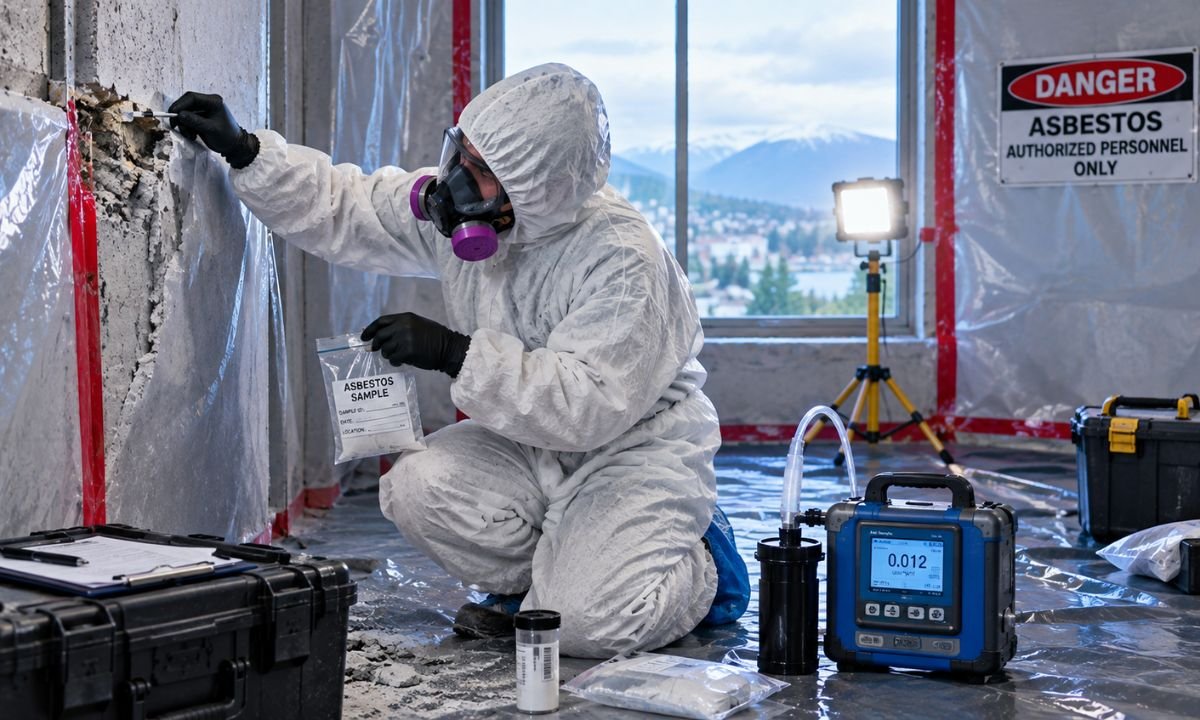
The exact procedure depends on the project, but a typical monitoring process may include:
1. Review the Asbestos Survey
The monitoring professional reviews the hazardous materials survey and determines which areas and materials are involved in the work.
2. Assess the Work Area
The containment, work area, nearby spaces, and planned removal procedures are reviewed to determine where monitoring may be appropriate.
3. Collect Air Samples
Air sampling pumps and collection cassettes are used to collect samples from the relevant areas. Worker exposure monitoring may also be performed when required.
4. Laboratory Analysis
Collected samples are sent for laboratory analysis to determine the concentration of airborne asbestos fibres.
5. Review the Results
The results are reviewed against the requirements applicable to the project. If additional cleaning or controls are necessary, the work area may need to be addressed before the next stage of the project.
6. Clearance Testing
Where clearance sampling is required, samples are collected after asbestos removal and cleanup. For high-risk work, WorkSafeBC requires clearance air sampling before containment is dismantled, with fibre levels not exceeding 0.02 f/mL.
Air Monitoring vs. Air Clearance
These terms are often confused.
Air monitoring is used during asbestos-related work to assess airborne fibre levels and exposure conditions.
Air clearance testing takes place after asbestos removal and cleanup when the project requires confirmation that the containment area is sufficiently free of asbestos fibres before it is dismantled.
For high-risk work, WorkSafeBC specifically requires clearance air sampling before the containment is removed.
WorkSafeBC Asbestos Requirements
British Columbia introduced new asbestos certification and licensing requirements on January 1, 2024.
Anyone performing asbestos abatement work in relation to a building must complete the required training and obtain the appropriate WorkSafeBC certification. Employers that carry out asbestos abatement work for others must also hold an asbestos abatement licence.
The certification level depends on the type of work being performed. WorkSafeBC also maintains a public registry that can be used to verify licensed asbestos abatement contractors.
These requirements apply separately from the question of whether a particular project requires air monitoring.
READ MORE: Air Monitoring for Asbestos in Maple Ridge
How Much Does Asbestos Air Monitoring Cost in North Vancouver?
There is no standard price for asbestos air monitoring.
The cost can depend on:
- Number of air samples required
- Size of the work area
- Number of containment areas
- Duration of the project
- Laboratory analysis
- Required turnaround time
- Whether clearance testing is needed
For this reason, a project-specific quote is more useful than relying on a general price range.
Before hiring a company, ask what is included in the quoted price and whether laboratory analysis and written reporting are included.
Can You Do Asbestos Air Monitoring Yourself?
Home testing kits are not a substitute for professional assessment where WorkSafeBC requirements apply.
Professional monitoring involves appropriate sampling equipment, calibration, sample handling, laboratory analysis, and documentation.
If asbestos may be disturbed during your renovation or demolition project, have the materials assessed first and determine what monitoring and control measures are required before work begins.
What Should North Vancouver Homeowners Do Before Renovating?
If you own an older property and are planning renovation or demolition work:
- Check the age of the building.
- Identify which materials will be disturbed.
- Have suspect materials assessed before starting work.
- Review the hazardous materials survey.
- Use appropriately qualified and certified asbestos professionals where required.
- Determine whether air monitoring or clearance testing is required for your project.
- Keep copies of your inspection, laboratory, monitoring, and clearance records.
For buildings constructed before 1990, the District of North Vancouver requires a hazardous materials survey before renovation or demolition work begins.
Common Mistakes to Avoid
Starting renovation before checking for asbestos
Older materials should be assessed before they are disturbed. Discovering asbestos after demolition has already started can create unnecessary delays and exposure concerns.
Assuming a material is safe because it looks normal
Asbestos-containing materials can look similar to materials that do not contain asbestos. Visual inspection alone cannot reliably confirm their contents.
Hiring an unqualified abatement contractor
Since 2024, WorkSafeBC certification and licensing requirements apply to asbestos abatement work in buildings. Check the contractor’s credentials before work begins.
Treating air monitoring and bulk testing as the same thing
Bulk testing determines whether a material contains asbestos. Air monitoring determines whether airborne fibres are present in the sampled area. They serve different purposes.
Removing asbestos without understanding the project requirements
Not every asbestos-containing material has to be removed immediately. The appropriate approach depends on its condition, location, and whether the planned work will disturb it.
Frequently Asked Questions
Do I need asbestos air monitoring for every renovation?
No. Monitoring requirements depend on the type of work and the potential for asbestos exposure. WorkSafeBC specifies air monitoring requirements for certain work activities, particularly high-risk work.
Is air monitoring the same as asbestos testing?
No. Asbestos testing normally involves sampling a building material to determine whether it contains asbestos. Air monitoring samples the air for airborne asbestos fibres.
Does a North Vancouver home built before 1990 need an asbestos survey?
For renovation or demolition work, the District of North Vancouver states that buildings constructed before 1990 require a hazardous materials survey completed by a qualified person.
Can I identify asbestos by looking at the material?
No. You cannot reliably determine whether a material contains asbestos based on appearance alone. Laboratory testing may be required.
What is air clearance testing?
Air clearance testing is performed after asbestos removal and cleanup when required to confirm that the area meets the applicable clearance requirements. For high-risk work, WorkSafeBC requires clearance air sampling before containment is dismantled.
Can the removal contractor perform asbestos abatement work?
Yes, provided the contractor and workers meet the applicable WorkSafeBC licensing and certification requirements. Employers conducting asbestos abatement work for others must be licensed, and workers performing building-related asbestos abatement must be certified.
How do I check whether an asbestos contractor is licensed?
WorkSafeBC maintains an online registry of licensed asbestos abatement contractors. Homeowners can use the registry to verify a contractor’s licence status.
What happens if asbestos is discovered during renovation?
Stop disturbing the suspected material and have it assessed by a qualified asbestos professional. The next steps depend on the material, its condition, and the planned work.
Can I stay in my home during asbestos removal?
That depends on the project, the work area, containment, and level of risk. Your asbestos professional and abatement contractor should explain any areas that need to remain off-limits during the work.
How long should I keep asbestos testing and monitoring records?
Keep your asbestos survey, laboratory results, monitoring records, and clearance documentation in your property records. These documents can be useful for future renovation work and property transactions.
Asbestos Air Monitoring in North Vancouver
If you are planning renovation, demolition, or asbestos abatement work in North Vancouver, dealing with potential asbestos before the work begins can help prevent unnecessary delays and exposure.
Enviromax provides asbestos testing, air monitoring, air clearance, and related asbestos services for residential and commercial properties in North Vancouver and surrounding communities.
For professional testing services, call +1 778 968 0258 or email Enviromax04@gmail.com. Our office is located in Surrey, British Columbia.
Areas We Serve
We also serve communities throughout Metro Vancouver and the Fraser Valley, including Vancouver, West Vancouver, North Vancouver, Burnaby, Richmond, Surrey, Coquitlam, New Westminster, Port Moody, Port Coquitlam, Maple Ridge, and surrounding areas.
Sources
- WorkSafeBC — Asbestos and asbestos exposure requirements
- WorkSafeBC — OHS Regulation Part 6: Substance-Specific Requirements
- WorkSafeBC — Asbestos training, certification and licensing
- WorkSafeBC — Licensed asbestos abatement contractor registry
- District of North Vancouver — Hazardous Material Reporting requirements