Enviromax Asbestos Consulting Ltd. provides independent post-abatement air clearance and Air Monitoring services for residential, commercial, strata, and restoration projects across British Columbia. After asbestos removal work is completed inside a containment area, clearance testing helps verify that airborne fibre levels meet applicable WorkSafeBC requirements before containment barriers are taken down and the space is reoccupied.
Our team works alongside homeowners, property managers, general contractors, restoration companies, and abatement contractors throughout the Lower Mainland and Fraser Valley to support safe project completion and clear documentation.
Our Asbestos Air Monitoring Services
Enviromax offers targeted Air Monitoring services tailored to the scope and risk level of each project in British Columbia:
- Post-Abatement Air Clearance: Final air sampling and visual inspection following asbestos removal to confirm the containment area is ready for teardown and reoccupancy.
- Containment Air Monitoring: Monitoring air quality inside active abatement enclosures during removal operations.
- Perimeter and Ambient Air Monitoring: Sampling outside containment boundaries and in adjacent occupied spaces to help verify that containment controls are holding.
- Clean-Room Monitoring: Air sampling within decontamination facilities and worker entry/exit areas.
- Occupational Air Monitoring: Personal exposure monitoring conducted for workers during asbestos-handling activities, where required.
What Post-Abatement Air Clearance Involves
Post-abatement air clearance is the final verification stage of an asbestos abatement project. Before a work area can be returned to normal use or handed over to other trades for reconstruction, the space must be thoroughly cleaned and evaluated.
A standard clearance process generally includes two main steps:
- Post-Abatement Visual Inspection: A qualified technician inspects the entire containment area, including surfaces, seams, poly sheeting, and equipment, to confirm that all visible asbestos debris, dust, and targeted materials have been removed. Air sampling does not proceed until the area passes visual inspection.
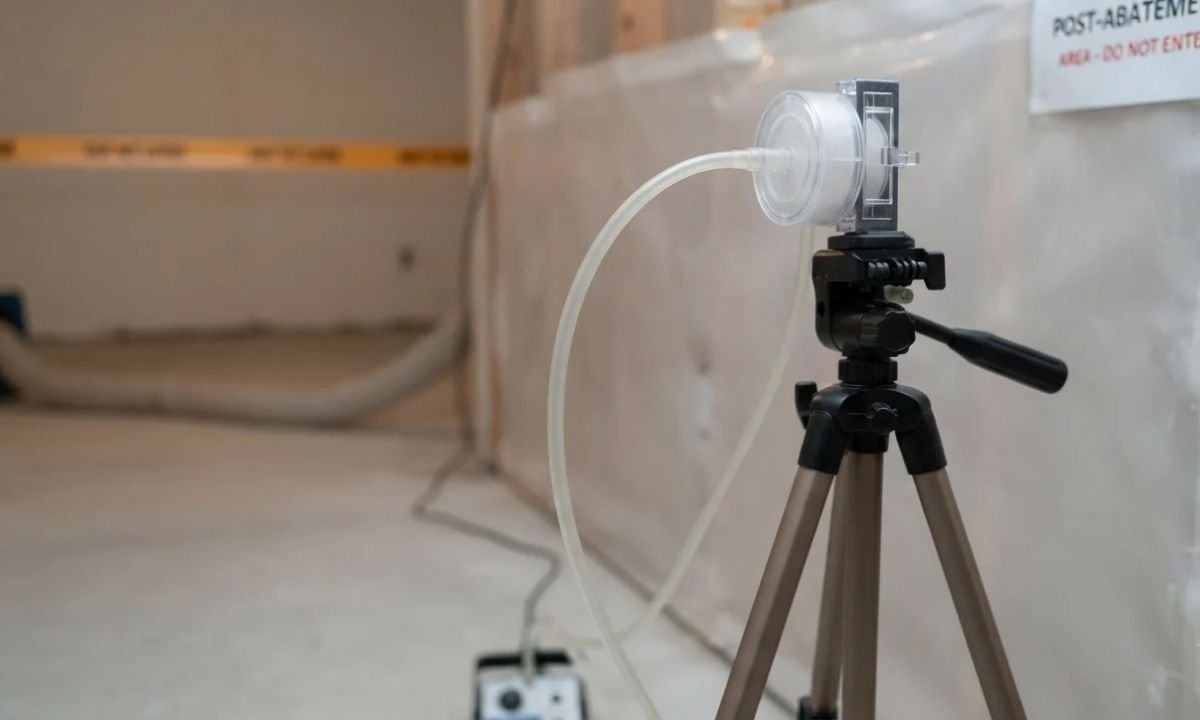
- Final Air Clearance Sampling: Calibrated air sampling pumps draw a measured volume of air through specialized filter cassettes inside the containment area. Aggressive sampling techniques may be used depending on project-specific requirements to simulate normal air movement and ensure settled fibres are not missed.
Samples are submitted for laboratory analysis to determine airborne fibre concentrations. Once results meet applicable clearance criteria, formal documentation is issued so containment barriers can be safely dismantled.
When Is Post-Abatement Air Clearance Needed?
Depending on the scope of work, risk classification, and applicable WorkSafeBC requirements, post-abatement air clearance may be required or recommended following asbestos removal across a range of property types in British Columbia:
- Residential Renovations: Following the abatement of drywall joint compound, textured ceilings, vinyl sheet flooring, or pipe insulation before general contractors resume work.
- Commercial and Institutional Upgrades: Prior to reopening retail spaces, offices, or public facilities after hazardous materials abatement.
- Strata Properties: When restoration or building envelope repairs involve common-area abatement and clear documentation is needed for owners and councils.
- Emergency Restoration Projects: After fire, flood, or water-damage cleanup where asbestos-containing materials were disturbed and removed under containment.
- Pre-Demolition Abatement: Where specific asbestos-containing materials must be cleared prior to structural demolition phases.
Independent Air Monitoring for BC Projects
Using an independent consultant for Air Monitoring and post-abatement air clearance provides objective oversight separate from the contractor performing the removal. Clear separation between abatement execution and clearance verification protects building occupants, property owners, and contractors alike.
Enviromax supports:
- Homeowners and Property Owners: Providing peace of mind and documented confirmation that living or working areas are clear following abatement.
- Property Managers and Strata Corporations: Supplying transparent third-party records for tenant communications, strata councils, and insurance files.
- General Contractors and Restoration Companies: Helping keep project schedules moving smoothly with timely site inspections, clear communication, and rapid reporting before trades re-enter the workspace.
- Abatement Contractors: Delivering reliable perimeter, containment, and final clearance testing to support regulatory compliance and closeout documentation.
Renovation, Restoration & Demolition Projects
In older British Columbia buildings, asbestos-containing materials are frequently uncovered during planned renovations, emergency restoration, or selective demolition. When these materials require removal, coordinating Asbestos Testing, Asbestos Removal, and post-abatement air clearance in the right sequence prevents costly delays and exposure risks.
Initial Asbestos Testing identifies which materials contain asbestos before work begins. Once containment is built and Asbestos Removal is carried out by qualified personnel, post-abatement air clearance bridges the gap between abatement closeout and the next phase of construction. Without proper clearance verification, tearing down containment prematurely can spread residual fibres into clean areas of the building.
Service Areas – British Columbia
Enviromax Asbestos Consulting Ltd. provides post-abatement air clearance and Air Monitoring services across the Lower Mainland and Fraser Valley regions of British Columbia, including:
Lower Mainland / Metro Vancouver
- Vancouver
- Burnaby
- Richmond
- Surrey
- Delta
- White Rock
- New Westminster
- Coquitlam
- Port Coquitlam
- Port Moody
- Maple Ridge
- Pitt Meadows
- North Vancouver
- West Vancouver
Fraser Valley
- Langley
- Abbotsford
- Mission
- Chilliwack
- District of Hope
- Agassiz
- Harrison Hot Springs
- Kent
Why Choose Enviromax Asbestos Consulting?
Enviromax Asbestos Consulting Ltd. (WorkSafeBC Asbestos Licence: AAL-00001650) delivers reliable asbestos consulting services across the Lower Mainland and Fraser Valley.
- Licensed Operations: Operating under WorkSafeBC Asbestos Licence AAL-00001650.
- Objective Third-Party Oversight: Independent visual inspections and air sampling conducted with professional rigour.
- Clear Documentation: Detailed clearance reports and air monitoring records suitable for contractors, property managers, insurers, and regulatory files.
- Project-Specific Support: Flexible scheduling for residential, commercial, strata, renovation, restoration, and demolition projects.
Frequently Asked Questions
What is post-abatement air clearance?
Post-abatement air clearance is a two-part verification process—combining a thorough visual inspection and air sampling—performed after asbestos removal is finished. It confirms that the containment area is clean and airborne fibre levels meet applicable WorkSafeBC criteria before containment is removed.
When should post-abatement air clearance be performed?
Clearance testing takes place after all targeted asbestos-containing materials have been removed, fine cleaning is complete, and the area has dried, but while the containment enclosure and negative air units are still fully intact and operating.
What happens if a containment area fails the visual inspection or air clearance?
If visible dust or debris is found during the visual inspection, or if air sample results exceed acceptable limits, the containment must remain sealed. The abatement contractor will need to re-clean the area before a follow-up visual inspection and repeat air sampling are conducted.
Is post-abatement air clearance required for every renovation in British Columbia?
Requirements depend on the type of asbestos-containing material, the risk level of the abatement work, and applicable WorkSafeBC regulations. High-risk and moderate-risk containment projects commonly require formal clearance testing, while project-specific conditions determine exact obligations.
Can a homeowner collect their own air clearance samples?
No. Post-abatement air clearance requires calibrated air sampling pumps, specific filter media, controlled flow rates, visual inspection protocols, and accredited laboratory analysis. Untrained individuals should never enter an active containment zone or disturb suspected asbestos materials.
How does post-abatement air clearance differ from occupational air monitoring?
Occupational air monitoring measures the airborne fibre exposure of workers while they are actively handling or removing asbestos. Post-abatement air clearance measures the air quality inside the enclosure after removal and cleanup are finished to verify the space is safe for reoccupancy.
BOOK POST-ABATEMENT AIR CLEARANCE ENVIROMAX ASBESTOS CONSULTING LTD.
Asbestos Testing | Air Monitoring | Air Clearance | Hazardous Materials Surveys
Call: 236-838-2640
Email: ENVIROMAX04@GMAIL.COM
Serving the Lower Mainland & Fraser Valley, BC
READ MORE: Final Asbestos Air Clearance British Columbia | Enviromax Asbestos Consulting