Enviromax Asbestos Consulting Ltd. provides independent containment air monitoring, occupational air sampling, and final clearance services across British Columbia. When asbestos-containing materials are disturbed or removed inside an enclosed work area, verifying that airborne fibres remain contained is an essential part of site management. Our team supports residential, commercial, restoration, renovation, and demolition projects throughout the Lower Mainland and Fraser Valley with objective sampling and clear project documentation.
Our Asbestos Air Monitoring Services
Enviromax delivers targeted air monitoring services tailored to the scope and risk level of active asbestos abatement and construction projects:
- Containment Air Monitoring: Sampling outside and adjacent to sealed asbestos work enclosures to verify that containment barriers and negative air units are functioning as intended.
- Occupational Air Monitoring: Personal air sampling conducted within the breathing zone of workers to help evaluate fibre exposure levels against applicable WorkSafeBC requirements.
- Clean-Room and Decontamination Monitoring: Monitoring inside decontamination facilities and clean rooms to help confirm that fibres are not migrating out of the work zone.
- Ambient and Perimeter Air Monitoring: Baseline and ongoing air sampling in surrounding occupied areas, hallways, or property boundaries during active abatement.
- Final Air Clearance: Post-abatement visual inspections and aggressive or non-aggressive clearance air sampling following cleanup and prior to containment teardown.
What Containment Air Monitoring Involves
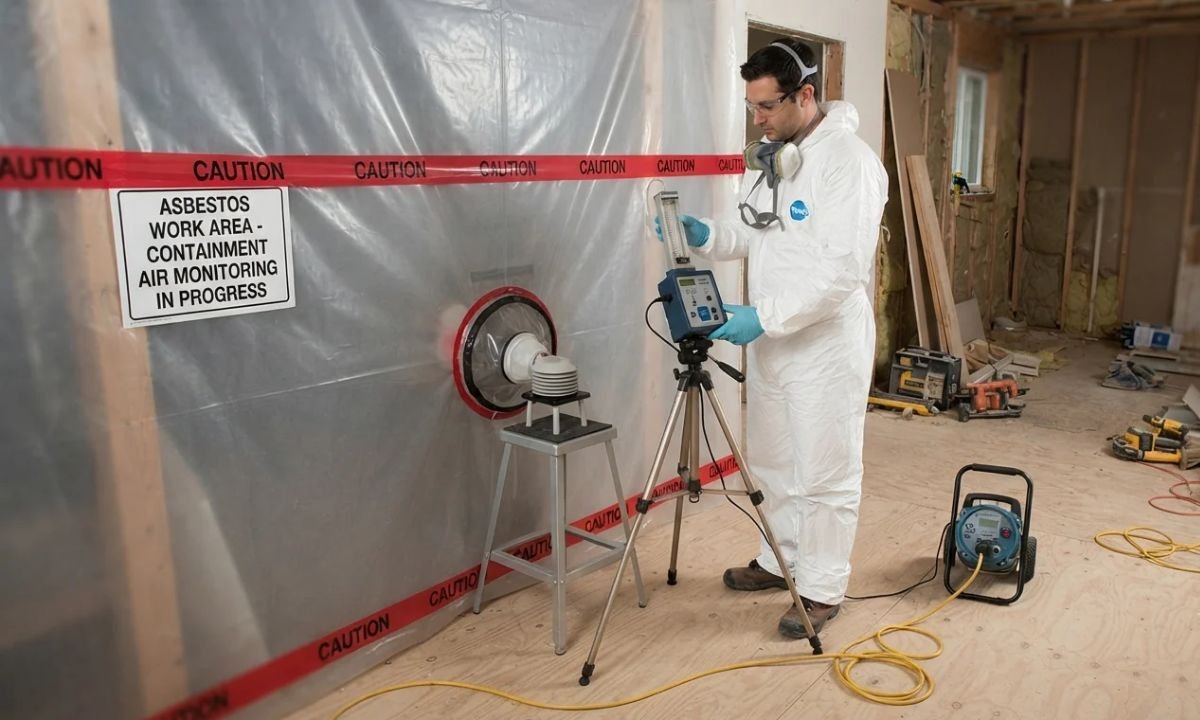
During high-risk and moderate-risk asbestos removal, contractors establish sealed poly-sheeting enclosures equipped with HEPA-filtered negative air pressure units. Containment air monitoring assesses the air quality immediately outside these barriers, near negative air exhausts, and at critical transition points such as decontamination chambers.
Using calibrated air sampling pumps and specialized filter cassettes, a technician collects measured volumes of air over a set period. The samples are analyzed to determine airborne fibre concentrations. If elevated fibre counts are detected outside the enclosure, site supervisors and abatement contractors receive timely data so they can inspect seals, check pressure differentials, and address potential breaches before fibres spread to adjacent areas.
When Is Containment Air Monitoring Needed?
Depending on the scope of work, risk assessment, and applicable WorkSafeBC requirements, containment air monitoring may be required or appropriate across a wide range of British Columbia projects:
- Occupied Commercial and Institutional Buildings: When asbestos abatement takes place in offices, retail spaces, schools, or healthcare facilities where neighbouring areas remain active.
- Multi-Unit Residential and Strata Properties: During suite renovations, plumbing riser replacements, or common-area remediation where residents occupy nearby units.
- Emergency Restoration Projects: Following fire, flood, or water damage in older structures where disturbed drywall mud, plaster, vinyl flooring, or pipe insulation must be removed under containment.
- Complex Renovations and Structural Demolition: On projects involving friable asbestos materials, mechanical insulation, or large-scale textured ceiling removal.
- High-Risk Abatement Work: Where regulatory procedures or project specifications call for continuous third-party verification of enclosure integrity.
Independent Asbestos Air Monitoring
Having an independent consultant conduct containment air monitoring provides objective oversight separate from the contractor performing the removal. Enviromax works alongside property owners, asbestos abatement contractors, general contractors, restoration companies, property managers, and strata corporations across British Columbia.
Independent monitoring helps establish a clear record of site conditions throughout the abatement phase. When combined with upfront [Asbestos Testing](Asbestos Testing) and proper [Asbestos Removal](Asbestos Removal) protocols, third-party air sampling supports transparent communication among building owners, tenants, contractors, and regulatory stakeholders.
Renovation, Restoration & Demolition Projects
Older homes, commercial buildings, and strata complexes across British Columbia frequently contain legacy building materials manufactured prior to the 1990s. When renovation, restoration, or demolition plans require removing these materials, establishing a sealed containment zone is often the primary engineering control used to protect surrounding spaces.
Containment air monitoring fits directly into the active abatement schedule. Before work begins, baseline samples may be collected to document existing airborne fibre levels. While abatement crews work inside the enclosure, ongoing containment and clean-room sampling verify that negative air systems and poly barriers hold steady. Once removal and fine cleaning are complete, a post-abatement visual inspection and final [Air Monitoring](Air Monitoring) clearance confirm whether the area is ready for containment dismantling and regular reconstruction trades.
Service Areas – British Columbia
Enviromax Asbestos Consulting Ltd. provides containment air monitoring and related asbestos consulting services across the Lower Mainland and Fraser Valley regions of British Columbia, including:
Lower Mainland / Metro Vancouver
- Vancouver
- Burnaby
- Richmond
- Surrey
- Delta
- White Rock
- New Westminster
- Coquitlam
- Port Coquitlam
- Port Moody
- Maple Ridge
- Pitt Meadows
- North Vancouver
- West Vancouver
Fraser Valley
- Langley
- Abbotsford
- Mission
- Chilliwack
- District of Hope
- Agassiz
- Harrison Hot Springs
- Kent
Why Choose Enviromax Asbestos Consulting?
Enviromax Asbestos Consulting Ltd. (WorkSafeBC Asbestos Licence: AAL-00001650) supports residential, commercial, restoration, renovation, demolition, and construction projects throughout the Lower Mainland and Fraser Valley.
- WorkSafeBC Licensed: Operating under WorkSafeBC Asbestos Licence AAL-00001650 for asbestos consulting and monitoring services.
- Project-Specific Monitoring: Sampling plans tailored to the specific containment layout, building occupancy, and risk level of your project.
- Clear Documentation: Straightforward analytical reports, sample logs, and clearance records suitable for project files, strata councils, and site supervisors.
- Responsive Service: Practical coordination with abatement crews, restoration teams, and general contractors to help keep project schedules moving safely.
Frequently Asked Questions
What is containment air monitoring?
Containment air monitoring is the collection and analysis of air samples outside a sealed asbestos abatement enclosure, near decontamination chambers, or at clean-room boundaries. It is used to verify that airborne asbestos fibres are not escaping the containment zone into surrounding areas.
When is containment air monitoring needed in British Columbia?
Containment air monitoring may be required or appropriate during moderate-risk and high-risk asbestos abatement, particularly in occupied buildings, strata properties, commercial facilities, and restoration sites, depending on project specifications and applicable WorkSafeBC requirements.
How is containment air monitoring different from occupational air monitoring?
Containment air monitoring measures air quality outside the sealed work area or within clean transition zones to verify barrier integrity. Occupational air monitoring places a sampling pump directly on an abatement worker to measure fibre concentrations inside their personal breathing zone.
What happens if elevated fibre levels are detected outside containment?
If air sample results show elevated fibre counts outside the enclosure, the abatement contractor and site supervisor are notified promptly so they can pause work if necessary, inspect poly seals and negative air units, correct any leaks, and clean affected areas before resuming.
Is final air clearance included after containment monitoring?
Final air clearance is a distinct post-abatement step performed after all asbestos-containing materials have been removed and the enclosure has been thoroughly cleaned. It involves a visual inspection followed by clearance air sampling before the containment barriers are taken down.
Can property owners or contractors collect their own asbestos samples?
Disturbing suspected asbestos-containing materials or conducting technical air monitoring requires specialized equipment, training, and adherence to safety protocols. Property owners and contractors should engage qualified asbestos professionals to handle testing, containment monitoring, and clearance procedures.
BOOK CONTAINMENT AIR MONITORING ENVIROMAX ASBESTOS CONSULTING LTD.
Asbestos Testing | Air Monitoring | Air Clearance | Hazardous Materials Surveys
Call: 236-838-2640
Email: ENVIROMAX04@GMAIL.COM
Serving the Lower Mainland & Fraser Valley, BC
READ MORE: Clean-Room Air Monitoring British Columbia | Enviromax Asbestos Consulting